

When I first booted up Grand Theft Auto 6, I rushed through the tutorial stuff and immediately abandoned Jason’s car. I was supposed to take it to the Pay ’n’ Spray. Instead, I sent it off down a boat ramp and went exploring.
I forgot about the car. There was an entire world out there, and that was what I wanted to see.
I have since got into the story, and I’m enjoying it. But the story isn’t the only reason I play Grand Theft Auto. Sometimes I want to wander off, poke at the world and discover what happens when I do something ridiculous.
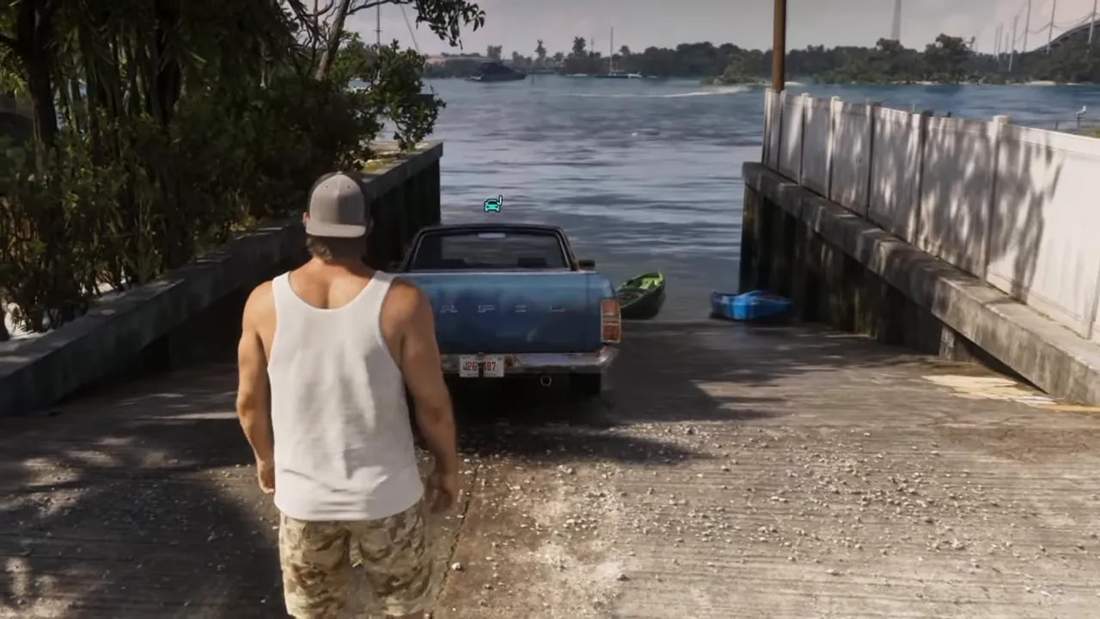
Within my first 48 hours, GTA 6 gave me experiences I had never had in a game before. It reminded me what this medium can do. And, strangely enough, this absurdly expensive, enormously ambitious game convinced me that AAA gaming needs to stop treating money and scale as the point.
The lesson isn’t that everybody needs to make something as big as GTA 6. That would be a terrible lesson. The lesson is to understand why any of this is fun.
Key Takeaways
- I see GTA 6’s real achievement as its fun, surprising interactions, not simply its enormous scale.
- Control Resonant illustrates why a smaller budget need not mean a lesser experience.
- “Perfect sevens” show how distinctive mechanics and identity can outlast technical shortcomings.
- I want AAA developers to match scope to resources while protecting the experiences that create wonder.
Rockstar’s Scale Is Not a Sensible Industry Standard
GTA 6 feels like the culmination of 13 years of planning, ideas and work. The amount of detail, the range of things to do and the fidelity holding it all together are extraordinary.
Could somebody identify an individual feature another game does better? Of course. I’m talking about the whole thing, though. Taken together, this is the cutting edge.
It is also what I’d call an irresponsibly large game.
I remember that description coming up around Final Fantasy VII Rebirth: a game with so much time, effort and money poured into it that its existence almost seems unreasonable. GTA 6 makes Rebirth look like a restrained budgeting decision.
But Rockstar occupies a position that almost nobody else can even approach. I don’t just mean that it employs talented people. Plenty of studios have talented people. I mean the combination of:
- The money to support an enormous production.
- Talent assembled over several decades.
- Experience building this particular kind of world.
- A vision that its resources actually allow it to pursue.
That combination matters. I cannot reasonably point at Rockstar and tell every other developer to do the same thing. Trying to become Rockstar by spending more money is not a strategy.
If scale alone defined AAA, GTA 6 would practically end the category. Everything smaller would have to accept a different label, because almost nobody should attempt to match this scope.
That is obviously ridiculous. So what am I actually asking other AAA games to learn?
Control Resonant Shows Why Budget Is the Wrong Measure
My answer starts with a very different game: Control Resonant.
I put it alongside GTA 6 deliberately. It delivers gorgeous visuals, plenty to do and the sort of experience I associate with a major AAA release. It has also attracted the kind of reception and commercial success that makes the label feel entirely natural.
Its budget, however, belongs in a completely different conversation.
The original Control had a budget of around $40 million. I assumed Resonant would cost at least twice that. Instead, the figure discussed is roughly $50 million. Against Rockstar’s spending, that almost looks like loose change.
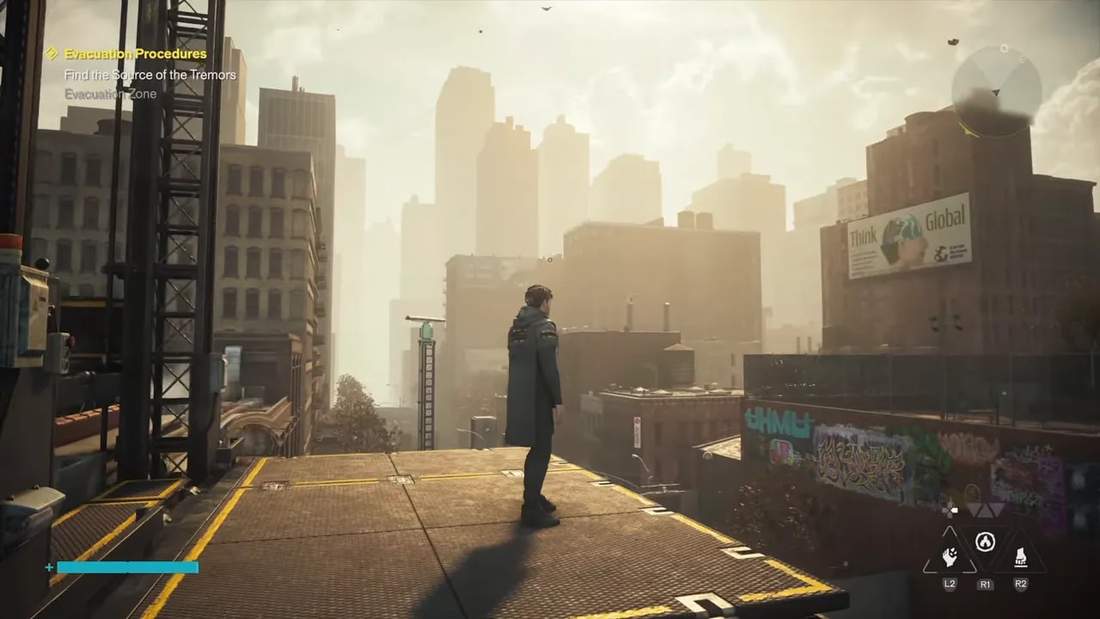
By the budget-based distinction I’m using, that places Control Resonant towards the high end of AA. Yet I don’t come away thinking I have received some lesser version of a big-budget game.
I come away remembering how it felt to play.
That is the useful comparison. These games operate at wildly different scales, but both give me things I cannot get elsewhere. Both make me feel something. Both justify the time I spend with them through the experience itself, rather than through a production-cost argument.
I’m not trying to rewrite an accounting category. I’m arguing for what AAA should aspire to mean to the person playing.
The “Perfect Seven” Explains What Expensive Games Sometimes Miss
To explain what I want from AAA, I actually need to talk about games that are less polished.
I call them “perfect sevens”.
A perfect seven is a game that probably deserves its seven-out-of-ten score. Its shortcomings are real. I’m not pretending the rough edges disappear because I happen to like it.
And yet I might enjoy it more than another game that is, by most conventional measures, better.
Red Faction: Guerrilla occupies a frankly unreasonable amount of space in my brain. Not because it is the biggest, prettiest or most comprehensively polished game I’ve played. It sticks with me because it has an unforgettable central mechanic, a clear identity and a kind of fun I want to return to.
Smashing apart its world is the point. Everything memorable grows out of that identity.
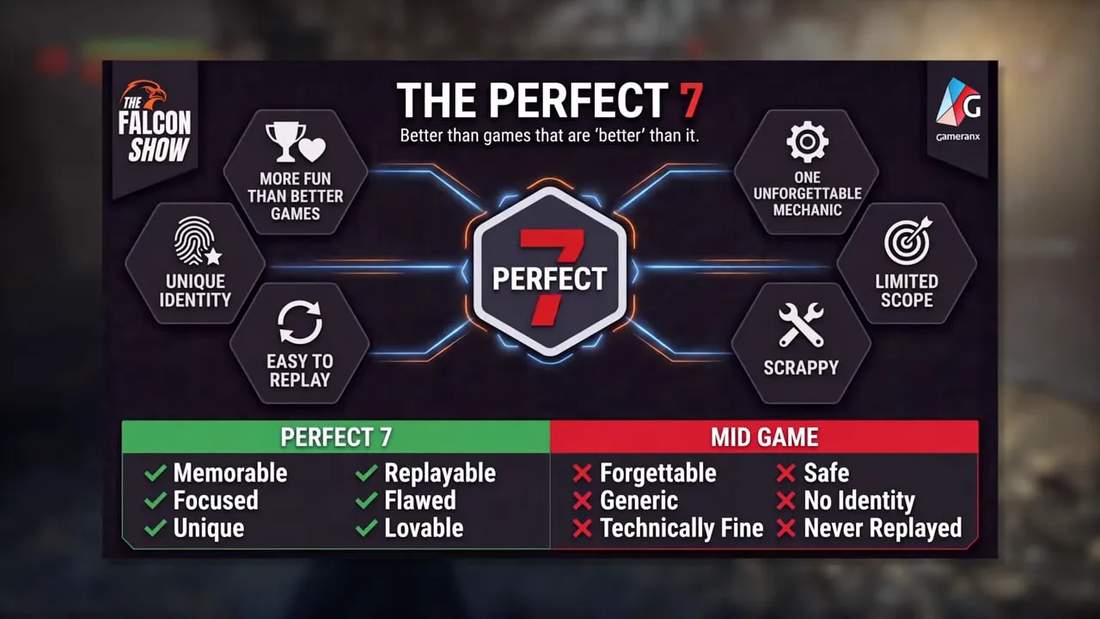
The qualities I’m talking about include:
- A memorable mechanic: something that immediately comes to mind when I think about the game.
- A unique identity: a reason to choose it rather than a technically superior alternative.
- Replayability: the urge to return because the act of playing remains enjoyable.
- A scrappy commitment to its idea: enough conviction to make that idea work despite limitations.
What I want from AAA is that same joy, but without so many of the caveats.
GTA 6 gives me the delight I get from a perfect seven without feeling like a seven. For me, this is firmly nine-or-ten territory. The important distinction isn’t the number, though. It is that the polish supports the fun instead of standing in for it.
A game can be more accomplished on paper and still leave less of an impression. That is the problem a massive production budget cannot automatically solve.
Feeling Like a Kid Again Is Not the Same as Nostalgia
A lot of games in 2026 have reminded me how much fun games can be. I’m thinking about Capcom’s continued strength in single-player games, Konami’s remarkable comeback, Control Resonant and plenty of other releases.
What connects them isn’t a uniform budget or a shared formula. It is the feeling that I’m getting an experience with its own reason to exist.
Even when a game resembles something familiar, it can distinguish itself through how it handles. Onimusha, for instance, can invite comparisons with Soulslikes, but I wouldn’t simply file it away as one. The feel is different, and that difference matters more to me than finding a tidy genre label.
I keep coming back to the phrase “feeling like a kid again”, but I don’t mean recognising something from childhood.
I mean encountering something new.
It is that moment when a game seems like a magic trick. I cannot believe somebody thought to include this. I cannot believe it works. I cannot believe I get to participate in it.
Nostalgia reminds me of an old discovery. Wonder gives me a new one.
That is what impresses me, not a budget announcement. I want the feeling that I’m part of another world, one that still has the capacity to surprise me.
A Polar Bear Encounter Gets to the Heart of GTA 6
One encounter captures what I mean better than any discussion of map size.
While messing around outside the story, I came across animal rights activists gathered around a truck. They wanted to free a polar bear, and they asked Jason to help.
Naturally, I helped. Naturally, letting a polar bear loose went horribly wrong.
The bear attacked the people who had released it. On its own, that would have been a perfectly good bit of Grand Theft Auto absurdity. There is an obvious, darkly comic consequence to deciding that an unsecured polar bear belongs in the street.
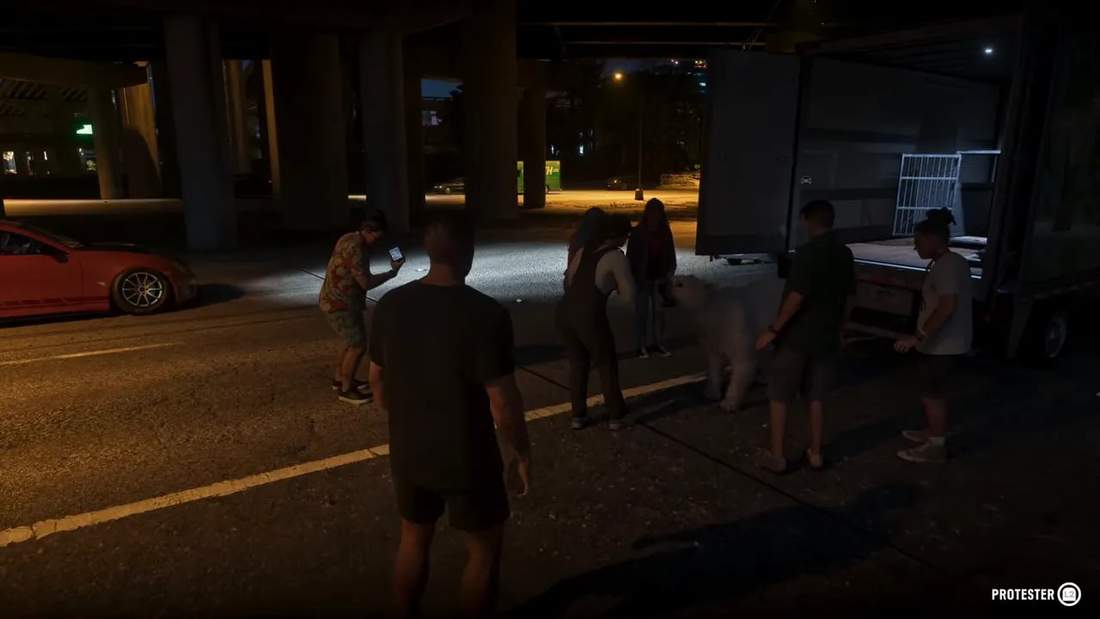
But the encounter didn’t stop at its initial punchline.
The commotion frightened nearby drivers. They tried to flee. One car accelerated over the face of somebody the bear had already mauled, spraying Jason with blood.
It was gruesome, confusing and genuinely surprising. I went from being horrified to being amazed that the game had allowed the situation to escalate that way.
I don’t know whether that exact sequence was intended. Maybe it is a regular outcome of the encounter. Maybe the traffic behaviour, character reactions and physics simply collided in a particularly horrible way.
That uncertainty is part of what made it memorable.
The broader idea is emergent gameplay: interacting systems producing situations that feel bigger than a single prescribed event. In this case, I couldn’t confidently separate the designed joke from the chaos that followed it.
And that is the crucial point. I did not need a world of GTA 6’s size to have that experience. I needed an interesting setup, convincing reactions and systems capable of carrying the consequences forward.
Reactivity Matters More Than Photorealism
I appreciate GTA 6’s visual fidelity. Of course I do. Seeing this much reactivity in a world that looks this good is astonishing.
But I don’t want publishers to mistake the presentation for the entire achievement.
Suppose the world were a tenth of its size, but still allowed the same kinds of interactions and unexpected outcomes. I think I would still be praising the essential experience.
Or suppose it had this level of reactivity but looked closer to the Saints Row game from a few years ago. Would that suddenly make the experience worthless to me? Absolutely not.
My surprise at the polar bear encounter didn’t come from counting the detail in the bear’s fur. It came from what happened, how the world responded and the way one event turned into something I hadn’t anticipated.
Control Resonant reaches me through a different kind of experience. It makes me feel things, shows me things I haven’t seen and lets me do things I could never do in reality. It doesn’t need Rockstar’s scope to accomplish that.
I believe the tools exist to deliver experiences people will receive as AAA on what has traditionally been considered a AA budget, particularly at the higher end. That doesn’t make development easy, and it doesn’t mean every ambition can be realised cheaply.
Rockstar pursued something that demanded extraordinary resources. My point is that not every worthwhile ambition demands Rockstar’s resources.
The Right Lesson Is to Match Ambition to Resources
There is a dangerous lesson the industry could take from GTA 6: bigger world, higher fidelity, longer production, more money.
I hope it takes the opposite lesson. Understand the experience first, then work out the scale that lets it remain compelling.
If a game has ten ideas developed to a remarkable extent rather than a hundred, those ten ideas can still be remarkable. Cutting the number of systems does not automatically reduce the quality of every interaction left behind.
What matters is whether the game keeps delivering on its central promise.
I would rather developers begin with a few basic questions:
- Why do I want to make this game?
- Why would somebody want to play it?
- What can this experience offer that another game cannot?
- What scale allows those qualities to keep working throughout the game?
- How can the available money and time best support that experience?
These sound obvious, but they get lost when ambition becomes a contest over quantities.
The biggest thing ever made can hold my attention for a while simply because it is big. Eventually, though, I have to enjoy being there. If it isn’t fun, who cares how much of it exists?
I see GTA 6’s scale as a reflection of its commitment to that feeling, not as a substitute for it. Rockstar can pursue an extraordinary number of little ideas and carry them unusually far. Another studio needs to choose more carefully. That is not the same as having nothing worthwhile to offer.
AAA Should Be About the Experience, Not the Spending Contest
I don’t expect another developer to compete directly with GTA 6. I don’t even think that should be the goal. There may not be another game with quite this combination of scope and detail until Rockstar attempts it again. God help everybody’s schedules when that happens.
What I do want is for the industry to recognise the part of its success that can travel.
Perfect sevens stay with me because they deliver something special despite their flaws. The best AAA games can deliver that same individuality with the resources to resolve more of those flaws. GTA 6 is an extraordinary example of that possibility, not an instruction to copy its production costs.
To put it crudely, AAA never needed to be a size contest. GTA 6 happens to have both the enormous scale and the experience to justify it. The second part is why I care.
I want developers to understand what they have, choose a scope they can support and maximise the potential of the ideas that make their game worth playing.
The future of AAA should not be about spending enough to resemble GTA 6. It should be about understanding how to make me feel that sense of wonder again.