
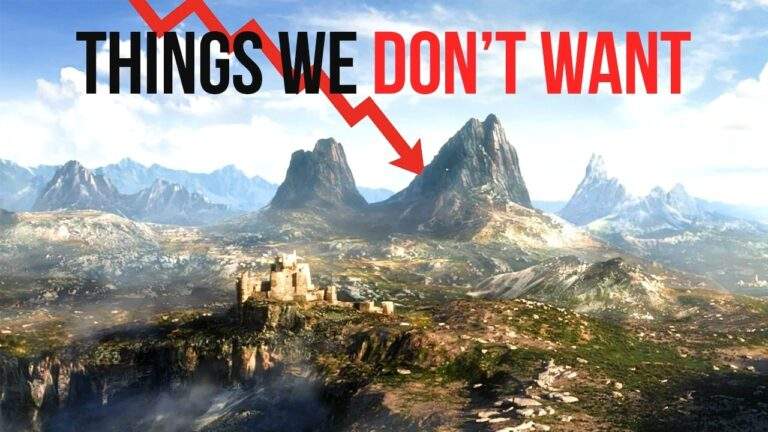
I want The Elder Scrolls 6 to give me a world worth getting lost in. Interesting towns, strange discoveries, rewarding dungeons and enough freedom to make a character feel like mine. That sounds straightforward, but Bethesda’s more recent games have given me a few reasons to worry.
Will crafting and settlement building swallow the exploration? Will shopkeepers have lives, or just stand behind counters forever? Will quests acknowledge my decisions, or hand me instructions and wait for me to obey?
Expectations have moved on since Skyrim. I still love what that game does well, but I don’t want its successor to ignore everything RPGs have improved since then. Equally, I don’t want Bethesda chasing other genres until the things that made The Elder Scrolls special become secondary.
These are my ten biggest concerns. They’re preferences, not predictions, and there’s plenty of room for disagreement. Bethesda fans agreeing on absolutely everything would probably be the strangest development of all.
Key Takeaways
- I want exploration and handcrafted discoveries to take priority over survival crafting and generated scale.
- Believable NPC routines, meaningful choices and less faction filler would strengthen role-playing.
- Unique loot and genuinely new powers would be more exciting than random legendary drops and recycled shouts.
- Better melee, more natural animation and fewer loading screens should modernise Bethesda’s strengths.
Table of Contents
- 10. Survival Crafting Taking Over the RPG
- 9. Crowds of NPCs Who Don’t Feel Like People
- 8. Meaningless Choices and Limited Role-Playing
- 7. Procedural Content Replacing a Designed World
- 6. Filler Quests That Get in the Way of Better Quests
- 5. Melee Combat That Still Feels Awkward
- 4. Legendary Loot That Makes Unique Rewards Feel Ordinary
- 3. Dragon Shouts With a Different Name
- 2. Stiff, Uncanny Animations
- 1. Loading Screens Around Every Corner
- I Want Bethesda’s Strengths, Not Its Habits
10. Survival Crafting Taking Over the RPG
Crafting isn’t the problem. Making everything revolve around crafting is.
I can appreciate the depth of Morrowind’s magic systems and the ridiculous possibilities of Oblivion’s alchemy. Being able to experiment, make something powerful and occasionally break the game is part of the appeal. What bothers me is when gathering materials becomes the dominant activity and crafted equipment makes exploration rewards irrelevant.
There’s something deeply disappointing about fighting through a dungeon, opening its final chest and finding a sword worse than the one I made sixteen hours earlier. That isn’t just a loot-generation problem. It’s a problem with how crafting fits into the wider game.
I’m more forgiving of scavenging and settlement construction in Fallout. Rebuilding in a ruined world makes sense. Establishing an outpost in Starfield makes sense on paper, too, even if the implementation doesn’t always fulfil that promise. The Elder Scrolls already has established societies and major cities. I don’t need another adventure built around re-establishing civilisation.
There is a middle ground. Something like Raven Rock in Morrowind’s Bloodmoon expansion, where a settlement develops through an extended quest chain, could work beautifully. I like seeing a location grow from almost nothing into a functioning community.
Just make that growth feel like an RPG storyline, not a survival game bolted onto the side. And whatever happens, leave a reason to care about the equipment hidden out in the world.
9. Crowds of NPCs Who Don’t Feel Like People
I’d rather have fewer NPCs with recognisable lives than a huge crowd that exists purely to make a city look busy.
One of Bethesda’s most distinctive strengths has been the impression that its inhabitants belong somewhere. A shopkeeper has a bed. Someone finishes work and heads to the tavern. People move through the town instead of remaining permanently attached to their assigned service.
These routines don’t have to be astonishingly complex. Their value is in what they imply: a job, a home and a life continuing outside my immediate interaction. That’s how a collection of buildings starts to resemble a society.
Starfield often loses that feeling for me. Its cities contain plenty of people, but too many feel like background population, while merchants can remain planted at their counters through the night. Fallout 76’s original lack of human NPCs was a much more extreme departure, although those characters were added later.
I’m not completely opposed to generic inhabitants. Kingdom Come: Deliverance offers a reasonable compromise between recognisable characters and background population. I could accept something similar, provided the important distinction is clear and there’s still a substantial population with believable routines.
I don’t need every passer-by to have a novel’s worth of dialogue. I need towns to feel inhabited rather than populated.
8. Meaningless Choices and Limited Role-Playing
An RPG loses something when the only way to complete a quest is to do exactly what I’m told, regardless of who my character is supposed to be.
Obsidian’s games at least tend to make an effort to support different resolutions. Bethesda sometimes does, too, but Skyrim has plenty of quests that offer a single route through. Many Daedric Prince quests are particularly restrictive: follow the intended sequence or leave the quest unfinished.
That becomes frustrating when I’m trying to play someone with a consistent outlook. Maybe my character would oppose the Thieves Guild rather than join it. Maybe discovering the Companions’ werewolf secret would create a conflict rather than become another step towards advancement. I want more room to act on those reactions.
I’m not asking Bethesda to turn The Elder Scrolls into Baldur’s Gate 3. That game’s density and branching structure serve a different kind of RPG, and transplanting the entire approach into a Bethesda open world might not work.
Former Skyrim lead designer Bruce Nesmith has defended Bethesda’s approach as enjoyable in different ways, even while praising Baldur’s Gate 3. Fair enough. Different approaches should exist.
But there’s a lot of space between an enormously reactive quest system and a rigid instruction sheet. At minimum, I want the game to recognise the character choices I make.
7. Procedural Content Replacing a Designed World
I don’t care whether every tree was placed individually by someone contemplating its artistic significance. That would be ridiculous. Procedural tools have their uses.
I do care whether the places that matter feel designed.
Starfield’s generated planetary environments made that distinction painfully clear. Scale alone doesn’t create an interesting world. A landscape needs reasons to explore it, and those reasons need to amount to more than another stretch of terrain between familiar activities.
Skyrim still holds up because its world has a strong sense of place. Whatever complaints I have about individual systems, the overall environment keeps inviting me to go somewhere. Its roads, towns, ruins and wilderness feel like parts of a world I want to understand.
That’s the priority I want preserved in The Elder Scrolls 6: an intentionally arranged world with dungeons that feel worth discovering. Randomness can support that work, but it shouldn’t replace it.
I don’t realistically expect Bethesda to abandon the approach of Skyrim and Oblivion for an entirely generated Elder Scrolls world. Still, the studio’s long-standing interest in procedural content, stretching back to Daggerfall, makes this worth mentioning.
A randomly generated dungeon might make more structural sense than some of Starfield’s planetary exploration, but that doesn’t mean it’s what I want. I want somewhere memorable, not merely somewhere enormous.
6. Filler Quests That Get in the Way of Better Quests
This is a different complaint from limited choices. A quest can be completely linear and still be excellent. What I don’t want is a basic task with no interesting challenge, no meaningful story and no particularly satisfying reward.
Some of those tasks are radiant quests. Others are fully scripted. Being handmade doesn’t automatically stop a quest from feeling like padding.
I don’t mind a game distinguishing major adventures from minor jobs. Skyrim often makes that separation reasonably clear. The problem is when low-effort jobs become compulsory steps in a faction’s progression.
The Thieves Guild is the obvious example. Its repeatable mini-jobs can make advancement feel more like completing a quota than establishing myself as a thief.
I prefer the principle behind Oblivion’s Thieves Guild progression, where fencing a required value of stolen goods helped unlock further work. The activity directly matched the role, while leaving me room to choose how to do it.
- I find a promising house or shop.
- I work out how to get inside and steal something valuable.
- I sell the goods and demonstrate that I can actually function as a thief.
That’s a much more natural relationship between role-playing and progression. Give me an objective that encourages the role, rather than a checklist that delays the next interesting mission.
5. Melee Combat That Still Feels Awkward
Bethesda’s close-range combat has room to improve. It can look clumsy, feel weightless and settle into fairly mindless exchanges of hits.
I don’t think the answer is to make The Elder Scrolls 6 a first-person Soulslike. Punishing combat isn’t the main reason I play these games, and I don’t want every encounter built around a stamina bar that empties almost immediately.
Better doesn’t have to mean harder. It can mean more satisfying.
I’d like weapons to behave more distinctly, rather than simply offering different numbers and slightly different swings. Directional attacks could add some variety. More convincing contact and reactions could make a successful strike feel like it actually connected.
Mods and combat overhauls already demonstrate how much interest there is in improving this side of Bethesda’s games. There are useful examples elsewhere, too. MachineGames’ Indiana Jones and the Great Circle makes first-person brawling feel wonderfully physical without turning every fight into a parry-timing examination.
I’m not suggesting that sword fighting should work exactly like punching someone as Indiana Jones. I’m saying there are ways to make first-person melee enjoyable without changing the entire audience or purpose of the game.
Starfield’s shooting improved, but its melee didn’t make a comparable leap. For a fantasy RPG where close-range fighting matters much more, I hope Bethesda gives it the attention it needs.
4. Legendary Loot That Makes Unique Rewards Feel Ordinary
Fallout 4 and Starfield both use versions of a legendary loot system: tougher enemies can drop enhanced variants of otherwise standard equipment, with randomly assigned properties.
I understand the appeal. Getting a surprisingly powerful drop can be exciting. That sort of reward loop fits naturally into something like Diablo.
But it can clash with the pleasure of exploring a Bethesda world. Finding a supposedly special weapon loses its impact when a random enemy already dropped something significantly better.
Fallout 4 still has unique weapons and armour to discover. The issue isn’t that authored rewards disappeared altogether. It’s that the random reward system can undermine them.
I’m much more interested in equipment with an identity. A stealth suit that makes its wearer invisible while crouching, for example, immediately suggests a purpose and a way to play. A distinctive armour set with bonuses connected to its theme is more memorable than another standard item with a lucky combination of modifiers.
Elden Ring understands how satisfying it is to find a particular reward in a particular place. Its exploration would lose a lot if every chest simply rolled on a generic loot table.
I want loot to feel connected to where I found it. That doesn’t require Bethesda to copy Souls combat or difficulty. It just requires intentional reward design, something Bethesda is already capable of doing.
3. Dragon Shouts With a Different Name
I like dragon shouts. Finding a new power at the end of a dungeon was a satisfying part of Skyrim, and the system belonged to that game’s central fantasy.
That’s exactly why I don’t want Bethesda to reproduce it with a new label.
Starfield’s powers already felt like diminishing returns on the idea. Acquiring them was repetitive, the abilities themselves often weren’t particularly exciting, especially at launch, and their thematic connection didn’t land as well for me as dragon shouts did.
There’s speculation about sword-singing becoming a major ability in the next Elder Scrolls. That’s a possibility to discuss, not something I’m treating as a confirmed feature. My concern is that any new power could end up functioning like the same old system underneath.
Some fans would rather abandon special protagonist powers completely and return to an Oblivion-style role, without a unique chosen-one ability. I’m not convinced that’s necessary. A distinctive power could be great.
It just needs an identity of its own. Change how it’s acquired, how it recharges or what it allows me to do. Ideally, rethink more than one of those things. A new setting deserves more than a reskinned signature mechanic.
2. Stiff, Uncanny Animations
Bethesda’s animations have a certain charm. I know that. I’ve enjoyed plenty of these games despite the awkward movements and slightly alarming conversations.
But affection for the old games isn’t a reason to leave this untouched forever.
Stiff bodies, unnatural facial movement and characters who seem frozen in place can break immersion. Starfield made an effort to improve facial animation, but its close-up conversations still frequently feel awkward. The camera zooms in and suddenly the interaction becomes a face delivering lines rather than a person having a conversation.
For me, The Witcher 3 had already established a stronger standard for conversational presentation back in 2015. I’m not demanding the most expensive, cutting-edge animation system imaginable. I’d just like a clear improvement that feels appropriate for a modern RPG.
This isn’t only about dialogue, either. Better animation could improve combat at the same time.
A strike that lands convincingly, an enemy who reacts properly and a character whose movement has some weight would address part of the melee problem without requiring a radically different combat system.
I can enjoy Bethesda’s quirks without wanting every old weakness preserved as a feature.
1. Loading Screens Around Every Corner
The biggest thing I don’t want is an adventure constantly interrupted by loading screens.
Entering a house shouldn’t routinely feel like leaving one section of the game and requesting permission to enter another. Modern open-world games have made seamless movement between outdoor spaces and interiors a normal expectation.
That doesn’t mean every game must eliminate every loading screen. It means the old pattern of placing a separate interruption behind seemingly every door is increasingly hard to accept, especially in an era of solid-state storage.
Starfield made this concern impossible to ignore. Moving between its different spaces could involve so much loading that the interruptions became part of the rhythm of playing.
I can acknowledge the ambition involved. Space combat, planetary environments and the rest of Starfield’s structure put different demands on Bethesda’s technology. Getting those systems working together was no small task. But technical effort doesn’t make repeated interruptions enjoyable.
The next Elder Scrolls is expected to continue using Bethesda’s in-house technology, and there has been talk of a further-developed engine referred to as Creation Engine 3. What matters to me isn’t the version number. It’s whether the underlying experience improves.
I want to walk into a shop, explore a building and move through a city with fewer breaks in the illusion. The world should feel continuous, not like a series of rooms separated by waiting.
I Want Bethesda’s Strengths, Not Its Habits
The common thread here isn’t that I want The Elder Scrolls 6 to become somebody else’s RPG. Quite the opposite.
At its best, Bethesda makes games that don’t feel like anything else: places full of possibilities, where a minor distraction can become the most memorable part of an evening. I don’t want that identity traded for survival crafting, random loot or sheer generated scale.
I want a carefully designed world, inhabitants who belong in it, rewards worth finding and quests that leave room for my character. Better combat, animation and fewer loading screens should support that foundation, not replace it.
Bethesda does things differently. Sometimes that produces something extraordinary. I just want the next Elder Scrolls to demonstrate the best reasons for that difference.