
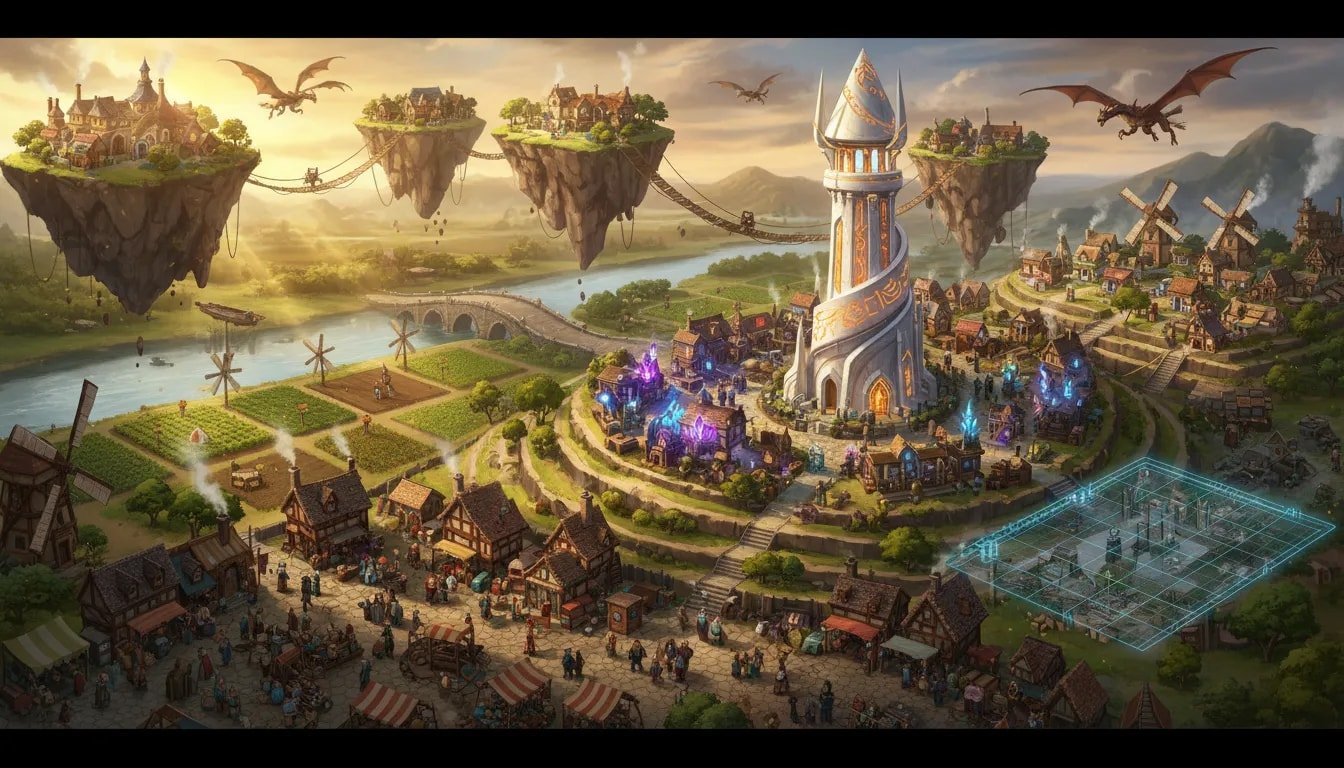
If you are searching for the Best New FANTASY City Builders to play in 2026, this guide highlights the top releases, what makes each unique, how to pick the right one for your play style, and practical tips for getting started. I focus on fantasy-themed citybuilding and colony-sim hybrids that add magic, myth, or fantastical races to traditional city management.
What counts as a fantasy city builder?
A fantasy city builder mixes the core systems of urban planning, resource management, and population logistics with fictional elements such as magic, mythical creatures, gods, or alternate races. These games range from tactical colony sims to narrative-driven builders with branching stories. Knowing which sub-type you prefer will make choosing the Best New FANTASY City Builders much easier.
How to choose the right fantasy city builder
Use this quick checklist to narrow choices before reading detailed notes below.
- Gameplay focus: survival, sandbox, roguelite, or political simulation?
- Scale: single village, citywide logistics, or empire-level supply chains?
- Difficulty: chill and aesthetic-driven or deep, punishing systems?
- Control style: direct placement vs indirect management and agent-based behavior?
- Content model: full release, early access, or games with active roadmaps?
- Mod and community support: important for long-term enjoyment in complex sims.
Top picks: Best New FANTASY City Builders (what each offers)
Dark Switch — vertical survival building with moral choices

Dark Switch combines vertical settlement design and survival pressure. You build upward on a giant living structure while defending against an encroaching threat and managing scarce resources. Expect limited space mechanics, expedition and airship trade routes, discovery of ancient artifacts, and narrative-driven campaign and sandbox modes.
Who this is for: players who enjoy tight spatial puzzles, survival choices, and a narrative layer to city management.
Quick tips
- Prioritize vertical planning early to reserve space for production chains.
- Use expeditions to secure rare resources rather than expanding endlessly.
- Balance moral choices with long-term sustainability; short-term gains can become permanent liabilities.
Goblins of Elderstone — survival colony builder with personality
Goblins of Elderstone is a survival city builder that centers on a goblin colony. Recent updates revamped the UI and added a move-building tool to reorganize cramped settlements. The core loop is resource gathering, base-building, maintaining favor with a patron deity, and handling rival threats.
Who this is for: players who like whimsical fantasy themes, survival pressure, and iterative updates with demo access.
Quick tips
- Use the move-building tool once you unlock it to optimize traffic and logistics.
- Integrate deity demands into production planning; ignoring them often has cascading costs.
Feastopia — roguelite culinary city building
Feastopia blends citybuilding with roguelite progression focused on food culture. Each run offers randomized maps and objectives where you build to satisfy a central, demanding entity. Progress unlocks persistent abilities, but failed runs reset the map and many resources.
Who this is for: players who enjoy short, replayable runs, unlock trees, and a charming art direction paired with mechanical challenge.
Quick tips
- Plan production for the central demand each run rather than full economy parity.
- Invest in persistent unlocks that support your preferred strategy—food production or trade.
Celestial Empire — Asian-myth inspired citybuilding
Celestial Empire draws on Asian mythology and historical trade systems. Core features include tiered housing upgrades, Silk Road-style commerce, and interactions with gods or spirit-class systems that influence growth. It leans toward a classic citybuilding loop while adding thematic mythological mechanics.
Who this is for: players wanting a culturally distinct citybuilder with narrative flavor and mid-complexity systems.
Quick tips
- Balance trade route investment with local production; one weak link can starve your economy.
- Watch for early access changes and patch notes; thematic titles often evolve significantly during development.
Nova Roma — low poly Roman survival and supply chains
Nova Roma applies a low poly aesthetic to Roman-themed citybuilding with fluid water dynamics, gods, and complex supply chains. It emphasizes survival-style resource management across an emergent empire rather than purely decorative city design.
Who this is for: players who like strategic resource networks, classical themes, and a clean, readable visual style that emphasizes systems over realism.
Quick tips
- Map your supply chains visually and keep chokepoints minimal.
- Use water and terrain to your advantage when planning logistics routes.
Songs of Syx — Dwarf Fortress-style grand fantasy sim
Songs of Syx targets players seeking massive-scale simulations. Expect tens of thousands of units, political systems, tactical battles, and deep agent behaviors. It sits at the intersection of colony sim and high-scale citybuilding, offering a living world that can simulate complex societal interactions.
Who this is for: players who want deep systems, emergent storytelling, and the freedom to manage massive populations.
Quick tips
- Start small to learn agent needs before spiking population growth; complexity scales quickly.
- Use modular infrastructure zones so you can adapt production to evolving demands.
Crown of Greed — Majesty-inspired indirect control
Crown of Greed revives the indirect-control formula where you influence independent heroes through bounties and incentives rather than direct orders. Expect a grim aesthetic, economy-driven kingdom expansion, and mechanics focused on persuasion and market manipulation.
Who this is for: players who prefer indirect micromanagement, emergent AI behavior, and kingdom-level economic play.
Quick tips
- Design incentive loops that align hero interests with your economic goals.
- Monitor agent satisfaction closely since indirect systems can create fragile emergent problems.
Common questions about fantasy citybuilders
Are fantasy city builders harder than historical or sci-fi city builders?
Difficulty depends more on systems depth than setting. Fantasy titles often add magic or divine mechanics that complicate planning, but many offer easier entry points or roguelite options. Check whether the game emphasizes survival, logistics, or roleplay to gauge difficulty.
Should I pick early access or wait for full release?
If you enjoy watching a game evolve and providing feedback, early access is rewarding. If you prefer stability and complete feature sets, wait for a full release. For the Best New FANTASY City Builders, several current titles are in early access and continue to receive significant updates.
Which games have good demo options?
Several newer fantasy citybuilders offer free demos—try demos to assess aesthetic and core loop before buying. Demos are especially useful for games with distinctive art styles or unfamiliar control paradigms.
Pitfalls and misconceptions
- Assuming art equals depth: Low poly or cartoon visuals do not indicate shallow mechanics; some of the deepest systems use simple aesthetics.
- Confusing genre labels: A game labeled citybuilder might play like a colony sim or roguelite. Read the feature list for persistence, population scale, and agent control before deciding.
- Expecting feature parity: Early access builds can change significantly. Expect features to be added, reworked, or removed during development.
Practical starter checklist for any fantasy city builder
- Play a demo or start on the easiest difficulty to learn core loops.
- Prioritize logistics early: storage, transport, and production chains.
- Reserve space for future expansion and specialized districts.
- Monitor agent needs and happiness; small deficits compound across systems.
- Save often and use multiple save slots when trying new strategies.
Final recommendations
For players seeking the Best New FANTASY City Builders, choose based on preferred systems rather than theme alone. If you like survival and narrative, try vertical survivors or campaign-driven titles. If you want grand scale and emergent politics, prioritize large-scale sims. Roguelite citybuilders are best if you enjoy repeatable runs with persistent unlocks.
I recommend trying demos where available, reading recent patch notes for early access titles, and picking one that matches your tolerance for complexity and development cadence. The current crop of 2026 fantasy citybuilders offers something for nearly every play style.
Quick summary
- Dark Switch: vertical survival with moral choices.
- Goblins of Elderstone: survival goblin colony with quality-of-life updates.
- Feastopia: roguelite culinary citybuilding.
- Celestial Empire: Asian-myth inspired trade and gods.
- Nova Roma: low poly Roman logistics and water dynamics.
- Songs of Syx: massive-scale, Dwarf Fortress-style simulation.
- Crown of Greed: Majesty-style indirect control and kingdom economics.
Use the checklist above to pick your first title, try a demo, and focus on mastering logistics early. These steps will help you get the most from the Best New FANTASY City Builders 2026 has to offer.