
Open world games have been around long enough that their worst habits are painfully familiar. Giant maps packed with repetitive icons. Radio towers. Side activities that feel like chores. Empty stretches between the good stuff. Main stories that claim to offer freedom, then shove everyone down the same narrow hallway anyway.
But every so often, a game comes along and actually addresses one of those problems. Not always perfectly, and not always without creating a few new issues of its own, but well enough to make the rest of the genre take notice.
These are ten legendary games that made open world design smarter, more immersive, more rewarding, or just a hell of a lot more fun.
Key Takeaways
- Ghost of Tsushima replaced intrusive quest markers with its immersive Guiding Wind navigation system.
- Fallout: New Vegas and The Witcher 3 pushed open world RPGs towards deeper, more consequential quest design.
- Breath of the Wild and Elden Ring made exploration feel freer and more surprising than standard icon-driven maps.
- Spider-Man 2 proved that open world traversal can be engaging enough to become the main attraction.
Table of Contents
- 10. Ghost of Tsushima Made Navigation Feel Natural
- 9. Far Cry 5 Broke the Radio Tower Routine
- 8. Bully Proved Smaller Worlds Can Feel More Alive
- 7. Batman: Arkham City Turned Its World into a Giant Level
- 6. The Witcher 3 Raised the Bar for Open World RPGs
- 5. Red Faction: Guerrilla Made Progression Feel Productive
- 4. The Legend of Zelda: Breath of the Wild Embraced Actual Freedom
- 3. Elden Ring Brought Back the Wonder of Exploration
- 2. Fallout: New Vegas Made Choices Interlock
- 1. Spider-Man 2 Made Traversal the Best Part of the Game
- What These Open World Games Got Right
10. Ghost of Tsushima Made Navigation Feel Natural
Ghost of Tsushima arrived at a time when plenty of open world games were borrowing heavily from one another. The most obvious shared feature was the endless sea of quest markers and giant UI arrows constantly telling me exactly where to go.
Those tools are understandable. Open worlds are huge, and a game needs to give me some way to find quests, characters, and objectives. Still, a bright line painted across the screen is rarely immersive. It is a gameplay contrivance sitting directly on top of a beautiful world.
Sucker Punch found a far more elegant answer with the Guiding Wind.
Rather than following a giant arrow, I can swipe the touchpad and trigger a gust of wind that blows towards my selected objective. It is simple, it is immediately readable, and it feels like part of Tsushima itself. No, I am not claiming a conveniently directional breeze would make sense in real life. But it feels much more at home in this world than a glowing GPS trail cutting through a field.
The mechanic preserves the feeling of travelling through a living landscape while still solving a very practical navigation problem. It also became so closely tied to Ghost of Tsushima that few games have tried to copy it directly.
I would still like to see more developers take the lesson from it: guidance does not have to mean clutter. A world can point me in the right direction without screaming at me through the interface.
9. Far Cry 5 Broke the Radio Tower Routine
For years, Ubisoft open world games had a very specific problem. I would enter a new area, find the nearest tall structure, climb it, activate it, and suddenly reveal every nearby point of interest. It was not awful the first few times, but Ubisoft used that idea so aggressively that it became a chore.
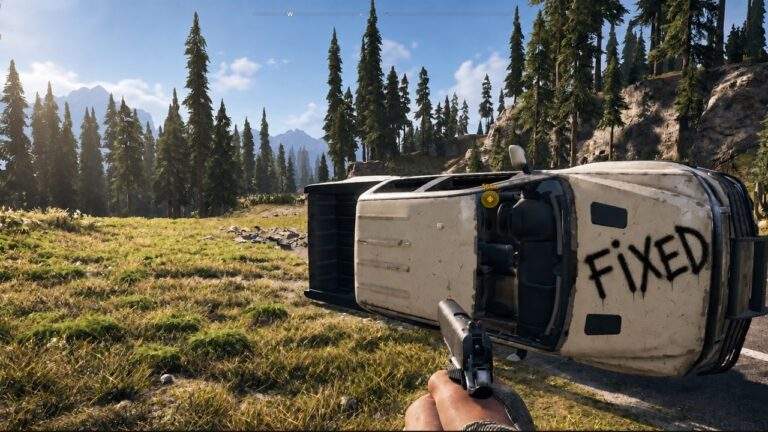
Far Cry 5 deserves credit for genuinely trying to solve the radio tower problem.
The game has its own issues. Its habit of forcibly kidnapping the player to advance the main story is one of the most frustrating examples of an open world game refusing to let me enjoy its own freedom. But its approach to discovery is excellent.
Instead of making towers the centre of exploration, Far Cry 5 uses environmental breadcrumbs:
- Radio broadcasts can point me towards activity nearby.
- Rescued civilians may share information about locations worth checking out.
- Road signs can identify useful places and add them to the map.
- Exploration itself steadily reveals new opportunities.
It is not the most naturalistic system ever made, but it roots map discovery in the world rather than in a repetitive checklist activity. I am encouraged to drive around, investigate things, and stumble into trouble instead of immediately beelining for another tower.
That basic idea has been copied plenty of times since, and for good reason. Far Cry 5 replaced radio towers with breadcrumbs, and that was a huge improvement.
8. Bully Proved Smaller Worlds Can Feel More Alive
Back in the early open world era, huge maps often felt more like amusement parks for chaos than convincing places where people lived. NPCs wandered around without much personality, most buildings were inaccessible, and there were rarely meaningful consequences for treating everybody around me like disposable scenery.
Bully took a different route. Its world is much smaller than a Grand Theft Auto city, but it is also denser, more structured, and far more believable because of it.
For a significant part of the game, I am limited to the school grounds. I have classes to attend, a curfew to respect, and dorm rules to follow. I cannot simply skip school and roam freely all day without consequences. If I get caught, prefects or police send me right back where I am supposed to be.
That limitation is not a weakness. It is the whole point. I am playing a kid in a school environment, so the world has rules that fit the character and setting.
The little details make the place work. Named students and characters move around campus, react differently depending on story progress, and respond according to their relationship with me. The setting does not merely exist to host missions. It feels like a place with routines, social hierarchies, and people going about their own business.
Rockstar later became famous for immersive worlds in games such as Red Dead Redemption, but I can see plenty of those ideas taking shape in Bully. Its small, dense open world showed that scale alone is not what makes a sandbox convincing.
7. Batman: Arkham City Turned Its World into a Giant Level
Open world games often struggle with level design. A map might contain a few great mission spaces, but the land between them can feel flat, empty, and interchangeable. Batman: Arkham City avoided that by making its open world feel like one enormous, intricate Batman level.
Arkham City is relatively compact, but it is packed with verticality, environmental puzzles, combat encounters, stealth opportunities, and traversal routes. It does not feel like a giant field full of points of interest. It feels designed.
The Riddler challenges are a great example. They are not simply collectibles scattered across a map for the sake of padding out the game. Many are actual puzzles integrated into the architecture, requiring observation, gadgets, timing, or creative use of Batman’s abilities.
The result is a world that constantly asks me to engage with it. Gliding through the city is fun, combat is fun, stealth is fun, and the map supports all of it without feeling separate from the mission design.
That cohesion is the major achievement. Arkham City is not just Arkham Asylum with more space. It is a larger, quasi Metroidvania-style game that keeps the dense, handcrafted level design principles of its predecessor intact.
Many series have tried to transition into open worlds and lost what made them special. Arkham City expanded its scope without losing its identity, which is much harder than it looks.
6. The Witcher 3 Raised the Bar for Open World RPGs
Open world games have often been criticised for trading depth for size. Even open world RPGs can fall into that trap, offering huge environments but quests that amount to basic errands, shallow systems, or repeated activities.
The Witcher 3: Wild Hunt helped close the gap between the scale of a AAA open world and the depth expected from a proper role-playing game.
Its production values were remarkably high, and they still hold up. More importantly, the quests feel carefully built. Even smaller jobs tend to involve dialogue, investigation, unexpected complications, unusual encounters, and meaningful context. A monster hunt is rarely just a marker leading me to a creature. There is usually a story around it.
The game made its missions feel consequential through a combination of:
- Detailed writing that gives even minor characters a sense of personality.
- Investigation mechanics that make Geralt feel like a professional monster hunter.
- Unique encounters and monsters rather than an endless stream of identical objectives.
- High visual fidelity that makes quest scenes feel richly staged.
- Unexpected twists that stop routine assignments from becoming routine.
Games such as Fallout: New Vegas had already delivered complex multi-step quests and meaningful outcomes, but The Witcher 3 combined that kind of ambition with a level of presentation that felt almost cinematic. It did not just ask open world RPGs to be bigger. It made it harder for them to excuse thin quest design by saying, “Well, it is open world.”
Not every part of The Witcher 3 is flawless. I will defend its combat more than some people, but I am not pretending it is the best combat system ever. What matters is that the game established a new expectation for how rich, handcrafted, and substantial an open world RPG could be.
5. Red Faction: Guerrilla Made Progression Feel Productive
Everybody talks about the destruction in Red Faction: Guerrilla, and obviously they should. Smashing buildings apart is fantastic. But the cleverest thing about the game may be its progression system.
Each major region has an EDF control meter. I can reduce enemy control by doing all kinds of activities, including destroying bases, saving rebels, and completing missions. Once I have weakened the EDF enough, I unlock the major operation needed to take down the local control hub and liberate the area.
The important part is that nearly everything contributes to progress.
That solves a common open world issue: the feeling that I need to clear every icon, complete every repetitive activity, and exhaust every corner of the map before moving on. Open world games can trigger a completionist impulse even when much of the available content is not actually enjoyable.
Guerrilla gives me a threshold, not an endless obligation. Once I have lowered EDF control enough, I can proceed. I do not have to do every activity. I can focus on the things I enjoy and still feel like every action is building momentum.
Far Cry 5 later used a somewhat similar regional progression idea, but Red Faction: Guerrilla does not punish thorough exploration by abruptly ripping me out of what I am doing for an unavoidable story sequence. It lets me move at my own pace.
That balance makes the game fast, focused, and replayable. It provides plenty to do without turning side content into a mandatory second job.
4. The Legend of Zelda: Breath of the Wild Embraced Actual Freedom
The Legend of Zelda: Breath of the Wild was primarily trying to reinvent Zelda, not fix open world games. But by rethinking the series, Nintendo created one of the most genuinely freeing open world experiences around.
After the opening section, I receive the core tools and can tackle major objectives in almost any order. If I have the skill and nerve for it, I can head straight towards the final dungeon remarkably early. That is what “open” should mean.
Many open world games offer freedom in theory while locking areas behind story progression, abilities, or arbitrary barriers. Breath of the Wild gives me a vast amount of agency from the outset.
Its greatest literal expression of that freedom is climbing. I can climb almost anything as long as I have enough stamina. Suddenly, mountains, ruins, towers, and cliffs are not just scenery or obstacles. They are routes.
Other games have copied the climbing mechanic because it is easy to see why it works. But the real magic comes from the broader design around it:
- I can approach objectives from different directions.
- I can experiment with tools, physics, weather, and the environment.
- I can choose my own path rather than following a rigid intended route.
- I can solve problems creatively instead of waiting for the game to hand me one approved solution.
There are valid criticisms, especially for people who prefer the more traditional Zelda structure of overworld exploration leading into major bespoke dungeons. Still, Breath of the Wild brought a level of systemic freedom to open world design that was rare then and remains difficult to replicate now.
3. Elden Ring Brought Back the Wonder of Exploration
There is a weird paradox at the heart of open world games. They are supposed to be huge worlds made for exploration, yet the genre is often associated with repeated assets, copied activities, and vast distances filled with not much of anything.
Smaller Metroidvania games can sometimes feel more rewarding to explore because their worlds are tightly designed around secrets, shortcuts, surprises, and discovery. Exploration feels good when somebody carefully builds things worth finding.
Elden Ring understood that better than almost any large open world game before it.
The Lands Between is full of moments that make me stop and go, “Wait, what?” I might find an elevator hidden in a forest and discover that it leads to a massive underground world. I might expand the map and realise the game is much bigger than I initially thought. I might notice something strange on the horizon, head towards it, and uncover an entirely new region, dungeon, boss, or path.
Open world games had delivered impressive discoveries before. Skyrim’s underground Blackreach is a standout example of a location that can genuinely surprise someone. Elden Ring’s difference is frequency. It does not rely on one or two massive reveals. It keeps delivering them.
It successfully combines the mystery, challenge, and environmental storytelling of a Soulslike with a truly huge world. There is filler, because no game of that size is entirely free of it, but its ratio of awe-inspiring discoveries is absurdly high.
Elden Ring made exploration feel mysterious again, and that is a major achievement for a genre that can so easily reduce discovery to ticking icons off a map.
2. Fallout: New Vegas Made Choices Interlock
Many open world games offer loads of quests, but those quests often feel disconnected. The world can become a collection of separate stories floating in a vacuum. I finish one side mission, then the main story continues as if nothing happened.
Fallout: New Vegas changed that by building an open world around complex, interlocking quest design.
The game gives me factions, competing interests, alliances, rivalries, and decisions that can affect the balance of power across the Mojave. The main plot, side quests, and faction conflicts all feed into the eventual Battle of Hoover Dam.
This is not a game where side content merely exists beside the story. A lot of it is the story.
My choices can determine which groups support me, which routes remain available, and how key events unfold. Some decisions close off other possibilities. I cannot experience everything in a single playthrough, and that is exactly why the world feels more reactive.
New Vegas does not define itself simply through the size of its map. Its real strength is player agency. I have room to decide who to work with, what values to support, and how I want the conflict to end.
That level of branching reactivity is difficult to make. New Vegas itself had a famously rough launch and was created on an extremely tight development schedule, but the ambition is still incredible. Even many later games have not attempted such an interconnected narrative structure at the same scale.
1. Spider-Man 2 Made Traversal the Best Part of the Game
Getting around is one of the biggest hidden problems in open world design. Even great games can make travelling feel exhausting. Maybe I am trying to find the correct road to reach an overpass. Maybe I am connecting roads to bridges. Maybe I am just running through an empty field for several minutes.
Spider-Man 2 on PlayStation 2 solved that problem in 2004 by making traversal fun as hell.
Spider-Man has always seemed like a perfect fit for an open world game because swinging through New York is central to the character. Earlier games had attempted it, but Spider-Man 2 made web swinging feel properly fast, physical, and skill-based.
The system is momentum-driven. It takes practice to get good at building speed, choosing routes, and moving smoothly through the city. That skill requirement makes it satisfying. I am not merely holding forward while the game carries me to the next objective. I am actively travelling.
The rest of Spider-Man 2 is decent, but swinging is the real star. Moving through the city can be as entertaining as the missions themselves, which is a massive deal for any open world game.
Later Spider-Man games have refined the formula in many ways, but the original remains hugely important because it was one of the first superhero games to truly nail superhero movement.
Its solution is difficult for other games to borrow outright, because web swinging is fundamentally a Spider-Man thing. Just Cause uses grappling hooks, and Saints Row eventually gave players flight, but neither feels quite the same. Still, Spider-Man 2 established a principle every open world developer should understand: travel should not be the boring bit between the fun.
What These Open World Games Got Right
The best open world games are not necessarily the ones with the biggest maps, the most icons, or the longest completion times. They are the ones that understand where the genre tends to go wrong and build smarter systems around those weaknesses.
Ghost of Tsushima made navigation less intrusive. Far Cry 5 made discovery less repetitive. Bully made a compact setting feel lived in. Arkham City made its whole map feel like a level. The Witcher 3 raised expectations for RPG quest quality. Red Faction: Guerrilla gave side activities real momentum. Breath of the Wild embraced freedom. Elden Ring made exploration wondrous. Fallout: New Vegas made choices matter. Spider-Man 2 made simply moving around an absolute blast.
When one game steals an idea, people call it a copycat. When enough games steal it, it becomes a genre convention. I am all for developers borrowing the right lessons from these games, because open worlds are at their best when they respect my time, reward my curiosity, and make every part of the journey worth doing.