The most interesting thing about Grand Theft Auto 6 is not simply that it promises a bigger map or prettier cars. It is the possibility that Rockstar is finally tackling the little annoyances that become very big annoyances after 50 hours. My thumb would certainly appreciate retirement from its second job as a sprint button hammer.
Across the reported previews and developer interviews, a pattern emerges: more freedom during missions, more believable consequences for crime, and a world that borrows heavily from Red Dead Redemption 2 without necessarily inheriting all its complications.
There is an important distinction here. Reported features, interpretations of footage, and leaks are not all equally certain. I am treating these details as the picture presented by the available coverage, not a substitute for testing the finished game. Some sound excellent. Others, particularly buying petrol, might be realism getting a little too pleased with itself.
Key Takeaways
- Reported changes target everyday frustrations, including repeated sprint tapping, heavy aim assist and rigid mission scripting.
- Crime systems are described as linking surveillance, identification, weapon concealment and escalating police responses.
- Red Dead Redemption 2 influences safe houses, NPC interactions, weapon storage and character upkeep, with some systems reportedly simplified.
- Map estimates, footage analysis and leaks carry different levels of certainty; the finished implementation remains the real test.
Table of Contents
- 20. Making Sprinting Less Exhausting for My Thumb
- 19. Giving the Shooting Some Max Payne 3 Weight
- 18. Keeping Missions from Constantly Taking Control Away
- 17. Making Escaping the Police More Than Driving Far Enough
- 16. Putting Some Actual Grand Theft Auto into Grand Theft Auto
- 15. Turning Shop Robberies into Proper Gameplay
- 14. Giving Safe Houses a Reason to Exist Beyond Saving
- 13. Addressing That Strange RAGE Animation Stutter
- 12. Making NPC Interaction More Than a Passing Insult
- 11. Filling the World Instead of Just Enlarging It
- 10. Localising Weather and Police Responses
- 9. Bringing Back San Andreas-Style Body Changes
- 8. Simplifying Red Dead Redemption 2’s Core System
- 7. Stopping the Entire Arsenal from Living in an Invisible Pocket
- 6. Letting the Main Characters Actually Spend Time Together
- 5. Building a Bigger Map with More Regional Variety
- 4. Giving Cars More Weight, Speed and Consequences
- 3. Separating Safe Savings from Money at Risk
- 2. Making Violence Feel More Physical
- 1. Making the Missions Better, Not Just Bigger
20. Making Sprinting Less Exhausting for My Thumb
Holding a button to run and repeatedly tapping it to sprint has been a Rockstar tradition for ages. I understand the appeal: putting in a little physical effort can make the action feel more deliberate. In Red Dead Redemption, that rhythm even fits the experience.
But crossing a huge open world on foot should not require a tiny endurance event on the controller.
GTA 6 is reported to introduce toggle-to-sprint through L3, the left stick button. Click it, sprint, done. It is an ordinary control scheme elsewhere, which is precisely why its arrival here matters.
I would expect alternative presets for people who prefer tapping, especially given GTA 5’s expanded control options. That is an expectation, though, not confirmation that the old scheme will return. The meaningful change is that repeated tapping apparently will not be the default.
19. Giving the Shooting Some Max Payne 3 Weight
GTA 5’s shooting was a substantial improvement over earlier games, but it never quite reached Max Payne 3. That game made firing a weapon feel forceful, responsive and physical. I have wanted more of that in GTA for years.
The reported GTA 6 changes point directly towards that influence:
- Reduced aim assist, making accurate shots less automatic.
- More pronounced recoil, giving weapons a stronger kick.
- Crosshair bloom, encouraging more considered firing.
- A returning slow-motion Focus ability, with highlighted areas indicating lethal and non-lethal hits.
Michael already had a slow-motion shooting ability in GTA 5. What interests me is the suggestion that the entire combat system, not just one special power, is moving closer to Max Payne 3.
There is also a practical reason to aim carefully: reportedly, weapons can be shot out of enemies’ hands. Disarming somebody could resolve a threat without turning a robbery into a murder. Better shooting is welcome. Better shooting that gives me more choices is considerably more interesting.
18. Keeping Missions from Constantly Taking Control Away
Rockstar can build an extraordinary open world and then become surprisingly strict about how I move through a mission inside it. Take the wrong route, stray from the intended sequence, or improvise at the wrong moment, and that freedom suddenly looks decorative.
In the reported IGN interview with Rob Nelson, the emphasis is on letting more of the action play out without locking everything to a prescribed path. A police escape, for example, is described as allowing different routes rather than demanding one particular getaway.
Some story situations also reportedly require Jason and Lucia to raise money through robberies while leaving the details to the player.
I am cautiously interested. Escaping the police freely is hardly a brand-new concept for GTA. The real test is whether that flexibility extends through the mission, rather than appearing only after the scripted portion has finished.
17. Making Escaping the Police More Than Driving Far Enough
The proposed wanted system sounds less like a single alarm and more like a record of what the police actually know.
Reported HUD icons distinguish between different kinds of identification:
- A camera icon: security footage has captured the character.
- A human silhouette: the police know the character’s appearance.
- A clothing hanger: the police know what the character is wearing.
That would make changing clothes or appearance relevant to escaping detection, rather than merely a way to spend money between jobs. The comparison that comes to mind is Hitman’s attention to surveillance and clothing, although that does not mean GTA is adopting its entire disguise system.
The coverage also describes six wanted stars rather than GTA 5’s five, allowing a wider range of responses. Threatening somebody with a gun, firing it, and actually shooting somebody are presented as distinct escalations.
Even openly carrying an assault rifle is described as attracting legal trouble. I would not turn that into a confident explanation of real Florida firearms law. The useful point is that, in the game, how conspicuous I am apparently matters before the first shot is fired.
16. Putting Some Actual Grand Theft Auto into Grand Theft Auto
For a series named after stealing cars, GTA has often made stealing cars remarkably basic. Pull somebody out, smash a window, or find an unlocked door. Congratulations, criminal career established.
The reported car theft system adds more decisions through a vehicle-scanning device called the WAINK scanner. Yes, apparently Rockstar is still Rockstar.
The scanner is described as revealing security information and resale value. Older vehicles can reportedly be opened with a slim jim, while newer ones may require a key-cloning tool. Certain tracking systems apparently introduce the ridiculous requirement to keep moving fast enough to avoid detection. Naturally, I find that very funny.
Stolen vehicles can reportedly be sold through a garage, giving opportunistic theft a clearer financial purpose. Keeping one for ordinary use is another matter, with registration described as part of making it street legal. Apparently even fictional criminal masterminds have paperwork.
15. Turning Shop Robberies into Proper Gameplay
GTA 5’s shop robberies could feel like an afterthought. Point a weapon, wait for the cash, leave. The surrounding world rarely made the situation as interesting as it should have been.
The reported GTA 6 approach connects robberies to identification, NPC behaviour, surveillance and escalation. A shopkeeper might comply. A pedestrian might flee. Somebody else might pull a gun and create a much worse afternoon.
A hollow wanted star reportedly indicates that police have received a report without enough identifying information. Concealing the weapon and leaving inconspicuously could therefore work differently from blasting out of the shop.
That makes preparation meaningful:
- Check for security cameras before starting trouble.
- Use a mask to reduce the chance of revealing the character’s appearance.
- Consider whether drawing attention is worth the potential reward.
- Avoid escalating a manageable robbery into a much more serious offence.
Cameras are not described as automatically hostile simply because I walk past one. The issue is being recorded committing a crime or being recognised while wanted.
Hidden systems also reportedly track what kind of criminal I become. I would not assume a precise reputation bonus yet, but the intended distinction seems clear: a careful robber and somebody who leaves a street full of bodies should not receive identical treatment.
14. Giving Safe Houses a Reason to Exist Beyond Saving
I like a nice fictional home. I like it considerably more when there is something to do inside it.
Safe houses are described as moving closer to Red Dead Redemption 2’s camps: interactive spaces where the main characters have routines, rather than expensive boxes containing a bed.
Reported activities include television and basic grooming. The hair detail is especially Rockstar: at home, cutting and shaving can only remove hair. A completely different hairstyle requires a salon. No instant miracle hair growth from the bathroom mirror.
Jason and Lucia having their own schedules could also make returning home feel more natural. I can imagine the potential for incidental conversations similar to RDR2’s camp interactions, but that remains an inference. The broader safe-house expansion is the reported feature; the exact range of missable events is not established here.
13. Addressing That Strange RAGE Animation Stutter
There is a particular animation hitch in Rockstar games that can make a character look as though they have briefly lost frames, even when the game’s overall frame rate has not dropped.
This concerns RAGE, the Rockstar Advanced Game Engine, not id Software’s game Rage or its id Tech engine.
The distinction matters because a frame-rate counter does not necessarily explain what looks wrong. The image can keep updating regularly while a character’s animation briefly advances unevenly.
Technical analysis discussed by GamesRadar’s coverage of the longstanding animation issue suggests newer footage may no longer exhibit the problem. Digital Foundry’s technical analysis is particularly relevant to this sort of distinction between animation behaviour and rendering performance.
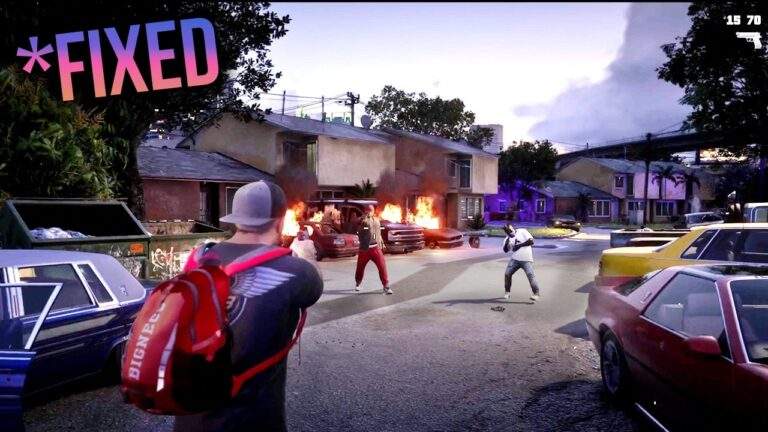
I would call that encouraging evidence, not proof that every instance has disappeared from the finished game. A still image cannot demonstrate the fix, either. This is one improvement that has to hold up in motion.
12. Making NPC Interaction More Than a Passing Insult
Red Dead Redemption 2 made speaking to strangers feel like part of inhabiting the world. GTA 6 reportedly brings that interaction model into a much busier modern setting.
Holding L2 to focus on an NPC is described as opening different interaction options. Conversations can respond to mood, location and time of day, while eavesdropping, antagonising people and following them may provoke different reactions.
One easily overlooked part of RDR2’s system was that repeated greetings could sustain a back-and-forth rather than merely trigger unrelated hellos. Expanding that idea across a metropolitan world is an absurdly ambitious undertaking.
Nelson reportedly describes a dedicated team of writers, producers and directors building dialogue for all those circumstances. That is the part I find exciting: not simply more people on the pavement, but more situations in which those people can respond.
11. Filling the World Instead of Just Enlarging It
GTA 4 and GTA 5 are impressive worlds. They can also look surprisingly sparse once I start paying attention to empty car parks and stretches of pavement.
The GTA 6 footage discussed in the previews presents a different target: crowded beaches, busy nightlife, fuller parking areas and heavier traffic. Streets are reportedly narrower where appropriate, rather than uniformly designed to make high-speed driving convenient.
That density matters outside Vice City, too. The natural environments shown include wetlands, abundant vegetation and wildlife. GTA 5’s dry countryside has its own appeal, but a swamp overflowing with life offers a very different kind of space to navigate.
I am more interested in that contrast than in a raw population claim. A busy city and a busy wetland should feel busy for completely different reasons.
10. Localising Weather and Police Responses
A rainstorm should not necessarily follow me across an entire state. Having lived in Florida, I can say that sunshine on one side of town and rain on the other is hardly an exotic concept.
Reportedly, GTA 6 uses persistent, localised weather rather than changing conditions everywhere at once. A storm at the beach might coexist with clear skies farther inland. Locations are also described as retaining evidence of weather, from puddles after rain to damaged roofs and fallen trees after severe storms.
The wanted system reportedly follows a similar regional philosophy. Different areas have their own police forces and wanted responses, with a persistent bounty-like element connecting consequences across regions.
There is a limit to geographical escape, though: the described six-star maximum triggers a statewide search. At that point, crossing a regional boundary is not supposed to make the problem somebody else’s paperwork.
9. Bringing Back San Andreas-Style Body Changes
I missed the freedom to make a GTA protagonist look dramatically different through food and exercise. San Andreas let CJ become muscular, gain weight, or generally look completely at odds with the seriousness of the scene.
The reported return of gyms suggests some of that flexibility is coming back. Working out can change the character’s physique, while overeating is described as having visible effects.
There is also a leak suggesting Lucia may need to enter a gym-focused social group during the story. I would keep that firmly in the rumour pile rather than treat it as an established mission.
The less speculative point is that food and training are presented as relevant to both appearance and character condition. I appreciate the practical benefits. I also appreciate the possibility of making Jason look thoroughly inappropriate for a dramatic crime story.
8. Simplifying Red Dead Redemption 2’s Core System
I love RDR2. Explaining every part of its core system without stopping to think is another matter.
GTA 6 reportedly translates some of that upkeep into a clearer arrangement: a dual-layer health bar and a stamina bar, with automatic recovery limited by the character’s underlying condition.
As described, damage can reduce the amount of health available for recovery. Food and rest restore condition more fully, while going too long without sleep reduces how much stamina can recover.
Training reportedly provides straightforward improvements:
- Strength training increases maximum health.
- Cardio training increases stamina.
The comparison that comes to mind is Dragon’s Dogma 2’s recoverable-health limitation, although that is a useful analogy rather than a claim that both systems work identically.
I would expect ordinary strenuous activity to contribute to progression, but that is an assumption. What matters is the reported effort to make health, fatigue and recovery easier to read without removing them altogether.
7. Stopping the Entire Arsenal from Living in an Invisible Pocket
Carrying a ridiculous number of weapons is not automatically a flaw. Doom and Wolfenstein manage it perfectly well, and I am not demanding a detailed inventory simulation from every shooter.
But a more grounded crime game can benefit from asking what I actually brought to the job.
The reported GTA 6 loadout allows two short weapons and two long weapons. Handguns and some compact weapons are described as concealable, while larger firearms need to be visibly carried, held or supported with a sling.
That connects directly to the wanted system. A concealed handgun and a conspicuous assault rifle do not create the same situation when entering a shop.
The rest of the arsenal reportedly stays in the personal vehicle, alongside spare clothes or disguises. It is essentially RDR2’s horse storage translated into a car. Faster, less likely to complain, and hopefully parked somewhere sensible when everything goes wrong.
6. Letting the Main Characters Actually Spend Time Together
GTA 5’s three protagonists came together for major story events, but their shared existence could feel compartmentalised. Outside those events, the game did not always make the most of having several leads.
Jason and Lucia’s reported partner system is intended to be more integrated. I can apparently explore solo or bring the other character along, with the companion acting as an ally rather than simply appearing for the next cutscene.
The partner can reportedly drive, help during trouble, and point out activities while travelling. Optional romantic interactions feed into a hidden relationship meter, although the full effects and limits are not clear.
I like the possibility of a companion who participates in ordinary play. Having somebody suggest an activity is a small thing, but it can make a relationship feel present between major plot points. And I am not pretending to be immune to the appeal of alligator-themed minigolf.
5. Building a Bigger Map with More Regional Variety
The map-size estimates discussed in the coverage put Leonida at roughly twice GTA 5’s size and three times Red Dead Redemption 2’s. Those are estimates, not measurements I have independently verified.
More useful than the comparison is the description of six major regions. Vice City anchors a wider setting containing national-park wilderness, inland communities, company towns, the Keys and a poorer stretch of coast.
That sounds more promising than one enormous city surrounded by increasingly empty terrain. Regional variety can change the scenery, the local population and the circumstances of getting into trouble.
Cars and aircraft should make those distances feel different from RDR2’s horseback journeys. Taxis are also described as returning, alongside conversational ride-sharing encounters and the option to let a partner drive.
I enjoy driving. Being trapped in unsolicited small talk is less appealing in real life, but in GTA it could at least be funny.
4. Giving Cars More Weight, Speed and Consequences
The vehicle changes sound like an attempt to combine some of GTA 4’s weight with GTA 5’s precision.
Reported improvements include heavier handling, increased top speeds and more noticeable differences in traction and road surfaces. Accelerating too aggressively can overwhelm grip, while targeting tyres can send vehicles spinning or crashing during combat.
That could become particularly chaotic alongside narrower roads, heavier traffic and more pedestrians. Higher speed is not automatically more useful when the entire street is full of obstacles.
Then there is fuel. Cars reportedly need petrol, while electric vehicles require charging at appropriate stations.
I am not yet convinced that stopping for petrol qualifies as an improvement. It could create useful planning decisions, or it could become the chore between the fun parts. The frequency and implementation will decide that, not the mere existence of a fuel gauge.
3. Separating Safe Savings from Money at Risk
The reported economy divides wealth into three forms:
- Banked money: savings described as protected from the losses associated with dying.
- Carried cash: spendable money that remains at risk.
- Stolen goods: physical loot that must be converted into cash.
Stolen goods are described as something that may need to be carried in a duffel bag and sold to a fence. Cash can then be deposited through an ATM.
That creates a useful distinction between completing a robbery and actually securing the proceeds. Getting the loot out is one problem. Reaching a fence and safely banking the cash is another.
I like the idea of retaining some protected savings without stripping danger from the immediate payoff. Depositing stolen money straight back into the banking system is also an extremely GTA kind of punchline. It is not, despite the obvious joke, evidence of an infinite-money exploit.
2. Making Violence Feel More Physical
GTA has never lacked violence. Its presentation, however, has often been less graphic than Red Dead Redemption 2’s.
The gameplay footage discussed in the coverage suggests more explicit injuries, stronger impact reactions and Max Payne-style slow-motion kill cameras. The examples include an explosive attack in an elevator and more elaborate close-range violence.
I would not automatically call more gore better game design. Its relevance here is the contrast with the expanded non-lethal options and escalation systems.
If a shooting looks and feels more consequential, choosing to disarm somebody instead may carry more weight. Whether that produces a more grounded experience or simply more spectacular chaos remains to be seen. Knowing GTA, I would not rule out both.
1. Making the Missions Better, Not Just Bigger
This is the change that ties everything else together.
GTA has always been good at combining activities. Driving, shooting, conversations and unexpected disasters can keep the overall experience entertaining even when an individual mission is mechanically ordinary.
GTA 5 raised the spectacle considerably, but I did not find its story especially weighty. RDR2 supplied that emotional heft, sometimes at a pace that required a very particular mood.
The reported GTA 6 ambition is to combine stronger character stakes with more open missions: alternate routes, fewer interruptions, less rigid sequencing and more room for player choice.
That is related to the earlier point about keeping control during action, but it goes further. A better mission needs both freedom and a reason to care about what happens. Jason and Lucia’s relationship could provide that context if their partnership matters during ordinary play as well as major story scenes.
That is the balance I want: Red Dead’s seriousness without losing GTA’s complete inability to behave itself. A huge map is impressive. A huge map where the systems support an interesting robbery, a believable escape and a relationship worth caring about is the part that could make the difference.