
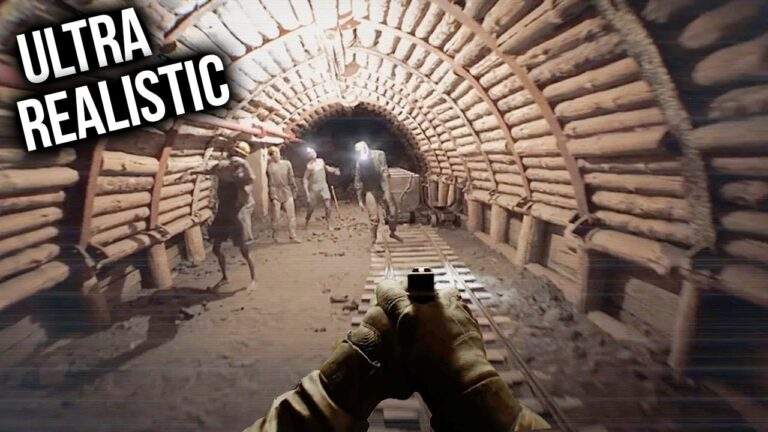
Bodycam is already a stressful shooter. Take its weighty movement, unnervingly realistic environments and stripped-back presentation, switch off practically every light, then throw a horde of undead into the mix. Calling the result stressful feels a little inadequate.
The 0.9 Dead and the Damned update makes Zombies a permanent part of Bodycam, rather than the limited-time mode it was previously. It brings back Village and Asylum, adds the new Trenches map, and gives me another very good reason to keep returning to this weird, brutal shooter.
Is this the deepest zombie survival mode around? Not even close. Is it occasionally one of the most intense horror shooter experiences I have played? Absolutely. There is something special here, even if the early access seams are still pretty visible.
Key Takeaways
- Update 0.9 makes Zombies permanent, with Village, Asylum and the new Trenches map.
- Ten-minute matches support up to four players, with free unlocks and no points-based buying system.
- Extreme darkness, weighty movement and lethal enemies make the familiar wave-survival formula feel different.
- I find it excellent for short co-op sessions, but limited map variety, rough edges and unreliable matchmaking hold it back.
Familiar Zombies Rules, Very Different Results
The easiest way to explain Bodycam Zombies is to start with Call of Duty Zombies. There are waves of enemies, mystery boxes to open and generators to power on. If that formula is familiar, I do not need to explain the basic appeal of holding out against increasingly dangerous undead.
But that comparison only gets me so far. Bodycam takes those recognisable ingredients and puts them inside a shooter that feels nothing like Call of Duty.
It also simplifies the structure considerably:
- Matches last 10 minutes. There is not much room for hanging around.
- Up to four players can play together. A full squad is where the mode really comes alive.
- There is no points-based buying system. Unlocks happen for free as the match progresses.
- The usual HUD remains absent. The action does not suddenly acquire a screen full of counters and indicators just because zombies have arrived.
I like how little time this wastes. It trades a lot of the shopping, planning and longer-term progression of Call of Duty Zombies for immediate pressure. The downside is that it also loses some mechanical depth, but the upside is a mode that gets to the good stuff almost immediately.
And the good stuff is firing a machine gun into near-total darkness with three friends, followed by a flash of lightning that briefly reveals the bodies scattered around the squad. It is ridiculous. It is also incredibly satisfying.
Village, Asylum and the Unforgiving New Trenches Map
The update has three Zombies maps: Village, Asylum and Trenches. The first two return from the earlier version of the mode. Trenches is the new addition, and it makes a pretty strong argument that things were not quite miserable enough already.
All three lean into Bodycam’s oppressive atmosphere, but Trenches is especially unforgiving. Its narrow, nearly pitch-black tunnels put fast undead right in my face before I have much chance to get comfortable.
A first attempt can be over within about 30 seconds. That is not much time to appreciate the scenery, although I suppose being mauled in a tunnel is one way to get acquainted with a map.
Village and Asylum feel more manageable alone, at least relatively speaking. I would still expect a rough introduction. Trenches is the one I would approach with a bit of map knowledge and a willingness to fail while learning it.
I appreciate having all three available permanently. I largely missed Village and Asylum during their first appearance, so being able to move between maps is a big part of why this update works for me. One brutally difficult map is a curiosity. A small selection gives me somewhere else to go after the latest embarrassing death.
The Darkness Is More Than a Visual Trick
A lot of games claim to be dark. What they often mean is that everything has a blue tint and I can still see the enemy standing across the room.
Bodycam Zombies gets properly dark. The closest comparison that comes to mind is the original Dying Light, although the settings are different enough that I would not call it an exact match. Here, darkness often swallows almost everything beyond a small patch of flashlight beam.
That makes the lighting enormously effective. A lamp or a brief flash in the distance feels almost comforting. Not safe, exactly. Just comforting enough to remind me how unpleasant the rest of the level is.
The game uses Unreal Engine’s Lumen lighting system, and this mode is an excellent showcase for it. Small amounts of light have an enormous impact because there is so little competing illumination.
I also think Bodycam deserves credit for how well the effects and performance come together in my experience. Unreal games often get discussed as though poor frame rates are an unavoidable feature of the engine. They are not. An engine is a starting point, not a substitute for optimisation. Bodycam, and another example I would point to in Subnautica 2, show why I am reluctant to blame the engine alone.
That is not a promise about every PC configuration. It is simply something I appreciate here: impressive effects that do not feel like they exist only to make the game run badly.
A Gun Without a Flashlight Can Be the Worst Mystery Box Result
The darkness also changes how I judge weapons. In Call of Duty Zombies, pulling a sniper rifle from a mystery box can feel like a joke at my expense. Bodycam can hand out sniper rifles too, and they have drawbacks, but they are powerful enough that I would not automatically write them off.
The really nasty result is a weapon without a flashlight attachment.
It does not happen often, but when it does, suddenly firepower is not my only problem. A powerful weapon is considerably less reassuring when I cannot see what is coming towards me.
That is a good example of how Bodycam changes a familiar mechanic without necessarily making it more complicated. The question is not just whether the gun hits hard. It is whether the gun lets me function in this particular nightmare.
One or Two Hits, and the Wave Is Over for Me
Death comes extremely quickly. A zombie can take me out in one or two hits, and there is no teammate revival system to soften the mistake.
Once I am down, I am out until the next wave. Nobody can rush over and rescue me.
That rule matters more as the enemies become increasingly aggressive. Some of the later zombies move in ways I genuinely did not expect. It is not just a case of making a familiar shuffling enemy slightly faster. Their movement can be startling, especially when my first clear look comes at very close range.
The combination is nasty: limited visibility, very little room for error and enemies that can close the distance quickly. A coordinated team makes a huge difference. Without one, a situation that seems manageable can collapse almost instantly.
It also pushes Bodycam into a different rhythm. The regular game is generally slow and careful. Zombies has me rushing around, firing on the move and trying not to let the horde catch up. I like that change of pace precisely because the underlying handling remains so distinctive.
Why Bodycam’s Movement Makes the Horror Work
The darkness gets a lot of attention, but I think the movement is just as important.
Bodycam has a tactile sense of weight and inertia. It does not offer the perfectly direct, frictionless control I associate with many other first-person shooters. There is some deliberate awkwardness to it, and that can take adjustment.
In this mode, that awkwardness is a strength. I feel like I am inhabiting a body that has to move through the environment, rather than steering a crosshair around a shooting gallery.
When a fast zombie appears, that physicality gives the panic some substance. Turning, aiming and getting away do not feel entirely detached from the person supposedly carrying the gun. The mode borrows Call of Duty’s basic structure, but that weight makes the moment-to-moment experience feel fundamentally different.
It is why I would love a full horror campaign built around this look and feel. The frantic escape from a horde is already convincing enough to make me want more than a short multiplayer session.
Solo, Private Matches and the Matchmaking Problem
One thing I really appreciate is the flexibility. Bodycam supports old-school privately hosted matches, and setting one up is straightforward.
The available approaches are simple:
- Quick Play: Join a public game through matchmaking.
- Private solo match: Learn the layouts without needing a group.
- Private co-op match: Bring friends and play with a team of up to four.
I think solo play is useful for learning the maps before joining a squad. Village and Asylum are relatively feasible starting points. Trenches alone is more of a commitment to practice and repeated punishment.
Public matchmaking has been less reliable for me. I have run into disconnects when joining random players, and the experience can vary with time zones and peak player numbers. Maybe some of that is bad luck, but it has happened enough to affect how I feel about the mode.
That is frustrating because a full squad is fantastic when it works.
I would much rather play with a reliable group of friends than depend on public matchmaking. Still, I like having the choice, especially when a solo match is such an easy way to learn the basics.
Brilliant Atmosphere, Limited Depth and Some Messy Edges
For all the praise, I do not want to oversell this as the ultimate zombie mode.
The maps are not as tightly designed as the best Call of Duty Zombies maps, and the systems are comparatively bare bones. Once I know a map, there is not a huge amount of variation waiting underneath it. I can easily imagine someone getting their fill after a few rounds.
The presentation also has some rough spots. The environments can look startlingly real, while the zombies themselves occasionally look like bargain Halloween decorations that have become far too enthusiastic.
Usually, the darkness and speed mean I barely have time to inspect them. But the illusion does break. Enemies can clip through doors before opening them, and the physics can get pretty wild when there are lots of bodies involved.
None of that is shocking for an early access game. It is still worth acknowledging, because this is not flawless immersion. It is an extremely effective atmosphere that sometimes gives way to a very obvious video game.
With only three maps and relatively limited mechanical depth, I do not think Zombies replaces Bodycam’s main offering or has enough here to sustain a separate audience indefinitely. As a short, terrifying co-op diversion, though, it is excellent.
Bodycam Is Becoming More Than Its Original Gimmick
When Bodycam launched in 2024, I could understand the impression that it was mostly a visual trick: realistic graphics, a fisheye lens and no conventional HUD.
Since then, the team has expanded on that concept. There is a solid shooter underneath the presentation, with a feel of its own, and major updates have made it increasingly worthwhile to revisit.
Zombies is only one part of it. The wider game also includes modes such as Wingman, Team Deathmatch, Versus, Hardpoint and Gun Game. Much of that offering revolves around team-based combat and variations on the deathmatch idea, but the regular shooting is a good time too. The 0.9 update also brings improvements beyond Zombies.
I still see some of the tech-demo quality in Bodycam. The technology remains a large part of the attraction, and this is not a finished 1.0 release. But I no longer think the presentation is the whole argument for playing it.
For price context, the offer accompanying this update was $26.65 until 20 November. That was a limited promotion, not a price I would assume is still available.
My recommendation is easiest for anyone who already owns Bodycam: give Zombies a try. For anyone considering buying it, I would go in expecting an evolving early access shooter with a spectacular but fairly compact horror mode, not a fully featured standalone Zombies game.
This is probably my favourite Bodycam update so far. It is short, sometimes messy and absolutely unforgiving. It also takes everything distinctive about the game and turns it into frantic co-op horror. I want the developers to build on it, because underneath the darkness, the strange physics and the inevitable attack from behind, there is the foundation of something genuinely special.