
After more than a decade of Silent Hill feeling like a dead series following the cancellation of Silent Hills, Konami’s revival has been surprisingly strong. Sure, Silent Hill: Ascension and The Short Message were not exactly confidence-inspiring starts, but the Silent Hill 2 remake was far better than it had any right to be, and Silent Hill f proved the series could take a genuinely different direction and still deliver.
Silent Hill: Townfall is another major swing. It is a first-person Silent Hill game set in Scotland, developed by Screen Burn Interactive, a studio previously best known for the well-regarded sci-fi puzzle game Observation. On paper, that is a risky proposition. In practice, it works way better than I expected.
It starts out with that familiar concern of an indie game trying to wear AAA clothes. The more I played, though, the more confident it became. This is not a walking simulator. It is not some unrelated horror game with Silent Hill branding slapped over it. It is a full-on survival horror experience, and it may be my favourite Silent Hill game of this modern era.
Key Takeaways
- Silent Hill: Townfall is a first-person survival horror game set in the detailed Scottish island town of St. Amelia.
- The portable CCTV system drives exploration, enemy detection, stealth, and puzzle-solving without making danger feel trivial.
- Its mix of vulnerability, limited resources, hiding, and IV bag revives creates sustained tension without excessive replay frustration.
- Despite a few control and enemy-variety issues, it is one of the strongest and boldest modern Silent Hill games.
Table of Contents
- A Scottish Silent Hill That Feels Incredibly Real
- The CCTV Is the Heart of the Horror
- Stealth, Scarce Resources, and Genuine Dread
- Old Technology Makes the Puzzles Feel Tactile
- The Story Takes a More Grounded Route
- What Does Not Work Quite as Well
- Silent Hill: Townfall Is a Risk That Pays Off
A Scottish Silent Hill That Feels Incredibly Real
Townfall drops me into the isolated island town of St. Amelia with almost no preamble. For a while, the entire experience is about wandering through this damp, foggy, deeply specific Scottish setting and soaking up the atmosphere.
The first-person perspective does a lot of heavy lifting. St. Amelia is one of the most detailed, lived-in environments I have seen in a horror game. Its narrow streets, waterfront walkways, tiny shops, cobbled lanes, faded signs, cramped homes, and grimy interiors all feel convincingly local. The developers being from Scotland clearly matters here. There are loads of small details that give the place a sense of identity rather than making it feel like generic spooky-Europe horror town number 47.
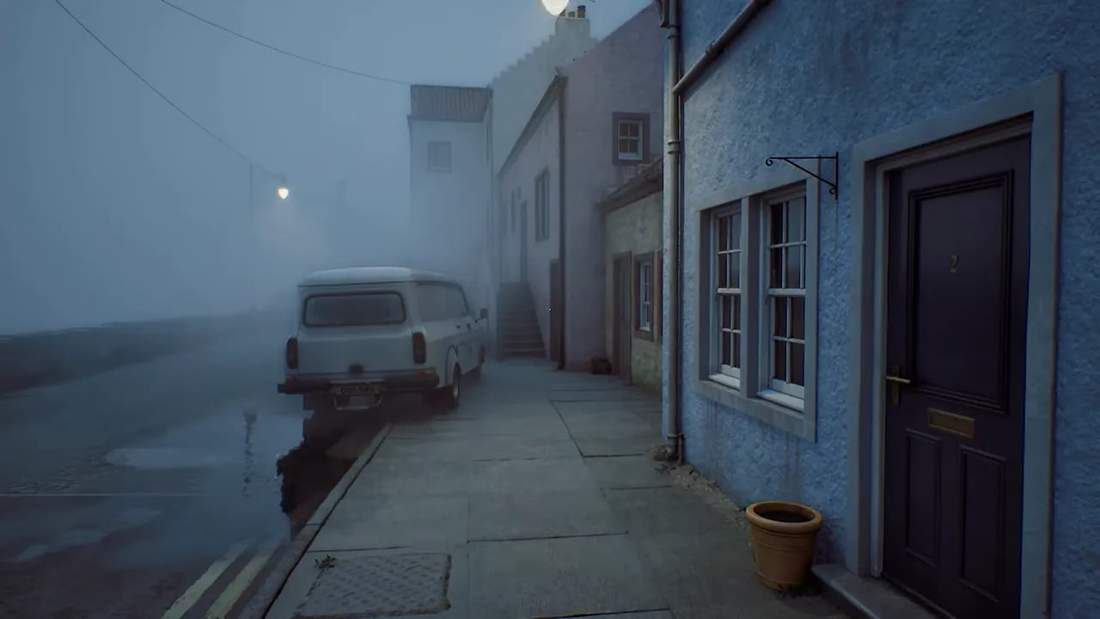
I played on PC with settings maxed out and ray tracing enabled, and it looks fantastic. More importantly, it stays detailed through the entire game, rather than blowing the visual budget on an opening stretch and then falling apart later.
The visual design of the Otherworld is much more understated than usual for Silent Hill. Instead of immediately going all-in on rust, flesh, industrial grotesquery, and music-video nightmare imagery, it leans into bare concrete, oppressive brutalism, and harsh red and blue lighting. At first I thought it looked a bit plain. As the game goes on, it starts to make a lot more sense. Those stripped-back spaces feel empty in a really unnerving way, and they become one of my favourite takes on the Otherworld in the series.
The CCTV Is the Heart of the Horror
The single best idea in Silent Hill: Townfall is the CCTV device. Early on, I get a portable television with an antenna, basically a much more advanced version of the classic Silent Hill radio.
It warns me about nearby enemies through static, but that is only the beginning. By tuning the device to an enemy’s frequency, I can use it to see where that monster is. It is vaguely comparable to sightjacking in the Siren games, except it is not a one-off novelty. This is the central mechanic that defines how Townfall plays.
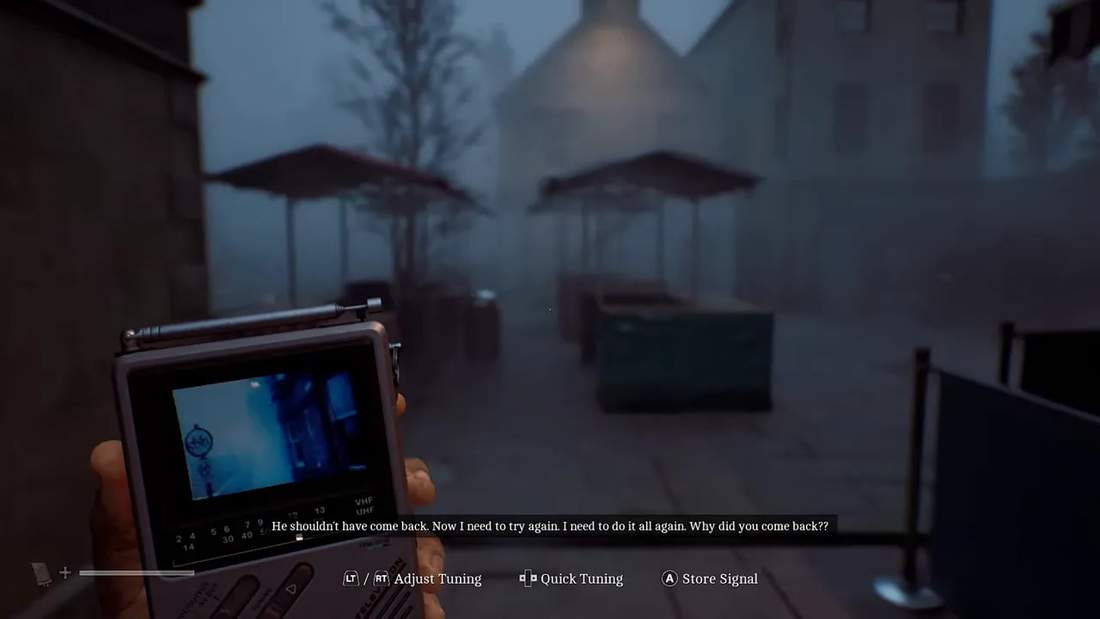
The CCTV can also pick up strange signals that offer vague hints, reminders, and bits of guidance. In true Silent Hill fashion, those clues are often ambiguous enough to make me work for the answer.
It sounds powerful, but it has important limitations:
- I can only focus on one enemy at a time.
- It can still be difficult to tell exactly where an enemy is in the physical space.
- Other creatures can move in from outside the screen and catch me completely off guard.
- Using it means splitting my attention between the device and the dark, horrible place around me.
That balancing act is what makes the mechanic work. The device gives me information, but never enough to make me feel safe. I am constantly checking it, second-guessing what it is showing me, and trying not to walk directly into something awful.
Stealth, Scarce Resources, and Genuine Dread
This is easily the scariest modern Silent Hill game for me, and it gets there without leaning heavily on jump scares or cheap gotcha moments. First-person perspective makes every narrow hallway and dark room feel more claustrophobic, but the real tension comes from how vulnerable protagonist Simon is.
A few hits can kill him. Breakable melee weapons eventually become available, and later there are guns and enough ammunition to actually use them, but fighting enemies head-on is almost never the ideal choice. Taking on a monster costs resources, exposes me to damage, and can turn a manageable situation into a disaster very quickly.
Stealth is usually the smarter move. Sneaking around enemies, hiding in closets, studying patrol routes, and trying not to get detected create an Alien: Isolation-style sense of dread. That comparison keeps coming up because it really does fit. This is not exactly Alien: Isolation transplanted into Silent Hill, but it captures a similar feeling of being hunted through hostile spaces with limited options.
The enemies also have a nasty habit of breaking expectations. A creature that looks like it is harmlessly standing around can suddenly start moving when I least expect it. They got me more than a few times that way.
Normal difficulty is not impossible, but this is not the kind of Silent Hill game I could casually stroll through. I reloaded saves more than I would like to admit. It is still easier than Alien: Isolation, but it creates the same stomach-dropping feeling in its best moments.
The IV Bags Solve a Classic Stealth-Horror Problem
One of the smartest systems in the game is the use of IV bags. Outside of automatic quick saves after major objectives, death sends me back to my last manual save, which can be a long way back. IV bags let me revive immediately after dying.
That might sound too forgiving, but it really is not. These things are valuable resources, and losing one hurts. What they prevent is the worst kind of trial-and-error frustration where getting caught means tediously replaying a long stretch over and over again.
That is a big deal in stealth horror. In games like the original Amnesia or Outlast, getting spotted can often be a flat pass-or-fail state. I get caught, I die, I reload. The tension slowly drains away because the game becomes a memorisation exercise. Townfall keeps the pressure on because surviving a mistake comes at a cost, but it does not always force a giant rewind.
It finds a really impressive balance between traditional Silent Hill survival horror and modern hide-and-seek horror design.
Old Technology Makes the Puzzles Feel Tactile
Another thing Townfall gets right is its love of chunky, obsolete technology. This is a game where using a phone to save does not just mean pressing a button. I have to physically key in the number to save.
Computers work the same way. I need to find the power button, turn the machine on, insert a floppy disk, and sometimes activate a printer before I can get the information I need. The game has its own operating systems, interfaces, ads, notes, posters, and tiny interactive details built into nearly everything.
A lot of the puzzle design comes from navigating these mundane tools. Most of it feels intuitive and logical, right up until it becomes abstract. Even then, there is usually a strange internal logic to the weirdness. I never felt like the game was asking me to solve puzzles simply because it wanted to be obscure.
That grounded interaction is a big part of why St. Amelia works. Every small action reinforces the sense that I am poking through a real town with real systems, not moving through a chain of obvious puzzle rooms.
The Story Takes a More Grounded Route
The story is another pleasant surprise. It starts out looking a little familiar: a man with gaps in his memory is searching for a woman. That setup naturally brings Silent Hill 2 to mind, and we have had plenty of stories working in that territory by now.
Thankfully, Townfall does not linger there too long. It gets the more obvious twist out of the way and expands into a story about multiple central characters connected to the downfall of the island town. Yes, that is absolutely the point of the title.
It is bleak, but it is also more grounded and real than the usual Silent Hill story. It is less purely psychological, which feels refreshing. The writing is strong, the presentation is consistently engaging, and even the minor characters are well handled. The voice acting is good across the board too.
Not every twist is going to catch anyone familiar with horror games completely off guard, but the story is good at using predictable setups as a launch point for something stranger. It keeps finding ways to move in more interesting directions than I expected.
What Does Not Work Quite as Well
I have very few complaints, especially after a bug-free PC playthrough, but there are some minor issues worth mentioning.
- The default controller controls for the CCTV are awkward. Holding LB to show the device while using LT and RT to tune it does not feel especially comfortable.
- Enemy variety is limited. New enemy types appear as the game goes on, especially from around the midpoint, but the roster is not the most visually wild Silent Hill has ever had.
- There are no traditional boss fights. I see this as a very minor complaint because the game is clearly aiming for a different structure, but it is still a departure from series expectations.
Even with the limited variety, the monsters feel thematically appropriate. I would much rather have a smaller group of enemies that fit the game’s mood than a bunch of random creatures that feel like they wandered in from another horror game.
Silent Hill: Townfall Is a Risk That Pays Off
Silent Hill: Townfall is a major departure from the traditional formula. It is set in Scotland rather than Maine or Japan. It uses a first-person perspective. It puts stealth and detection at the centre of the experience. Its story takes some big swings outside the usual Silent Hill comfort zone.
But it still understands the stuff that matters. The dreamlike atmosphere is there. The guilt is there in huge quantities. The sense that the town itself is reflecting something rotten and deeply personal is absolutely there.
Most importantly, it is just a very good survival horror game. It is scary, well paced, loaded with tiny environmental details, and it keeps getting better as it goes. There is no point where I felt like I was simply dragging myself through another few hours to reach the ending. It builds momentum instead.
Considering how risky the whole project sounded, that is kind of wild. Konami has somehow breathed real life back into Silent Hill after years of it feeling impossible, and Townfall might be the boldest success of the lot. For me, it is probably the best post-PT Silent Hill game so far.